Everything is everything
Refurbished notes on rhizomatic learning
Knowledge can feel like a garden, and I’m inclined to think that way since I’ve found spaces like this. Dave Cormier describes what successful learning looks like :
Knowing is a long process of becoming (think of it in the sense of ‘becoming an expert’) where you actually change the way you perceive the world based on new understandings. You change and grow as new learning becomes part of the things you know.
This is him describing a ‘community curriculum’ :
A curriculum for a course is something that can be created in time, while a course is happening. The syllabus becomes a garden space, a context setting within which learning can happen and the curriculum is the things that grows there
Overlaps between ’digital gardens’ and ‘community curriculums’ :
- Spotting connections between two ideas
- Celebrating learning as messy, organic serendipity
🥔 The rhizome as a metaphor
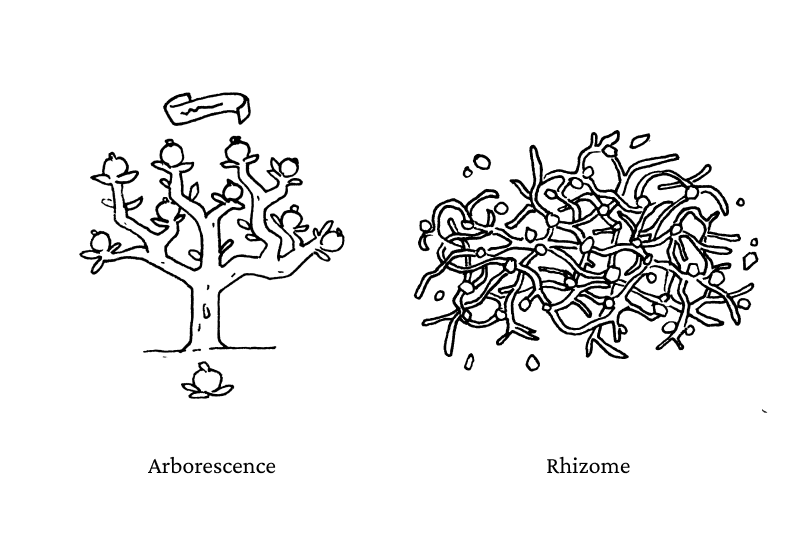
In the traditional sense, knowledge could be thought of as a tree. Ideas are born from a seed, growing into a tree and every new ‘branch’ can be tracked back to the start. Learning is progressive and sequential here. Deleuze and Guattari used the term Arborescence to describe this model.
The Rhizome, on the other hand, is a non-linear model for knowledge and society. Like the plant, it has no start or end, and has multiple offshoots and nodes. It values connections over chronology. This model helps us see things around us as a result of multiple forces, all connected to one another.
Why this matters today
Knowledge-making can be exclusionary and slow. It’s a linear process, where your learning needs to be gathered, meticulously arranged, compared to old knowledge and then certified by a body of experts. Gatekeepers could potentially decide what becomes canon or not.
Learning can start to feel like a steep climb.
Students today can nosedive into the world’s biggest rhizome : the internet. It’s a framework for navigating not just your ecology of knowledge, but a shared one with your peers. In a setting like this, a modern day educator is bound to ask : ”What am I going to teach my students that the internet cannot?”
So in this model, the educator is responsible for setting the space within which the learning takes place. Their role changes from being a source to a signpost. Learners are then free to explore in any direction. They can constantly create, collect, remix and riff off of each other’s data to decide what becomes knowledge.
Learning can then feel shared and networked.

Where do we start when there seem to be no answers for the questions we hold? A rhizomatic approach says we start within, because the knowledge we hold is valid too. And then we work our way outwards to connect our learnings with each other’s, constructing our own histories in the process.
Everything is everything. Complex is beautiful and connections are all powerful.
Also see Pedagogy of the Oppressed